What the plugin stores
Newsletter → Configuration → Data collected — a tab of its own next to Settings, Modules and Help.
The backend uses the short form
Messages from the plugin write „Newsletter → Data collected" without the intermediate step. The same tab is meant.
A pure information page — no form, no switch. It shows what is stored on your installation.
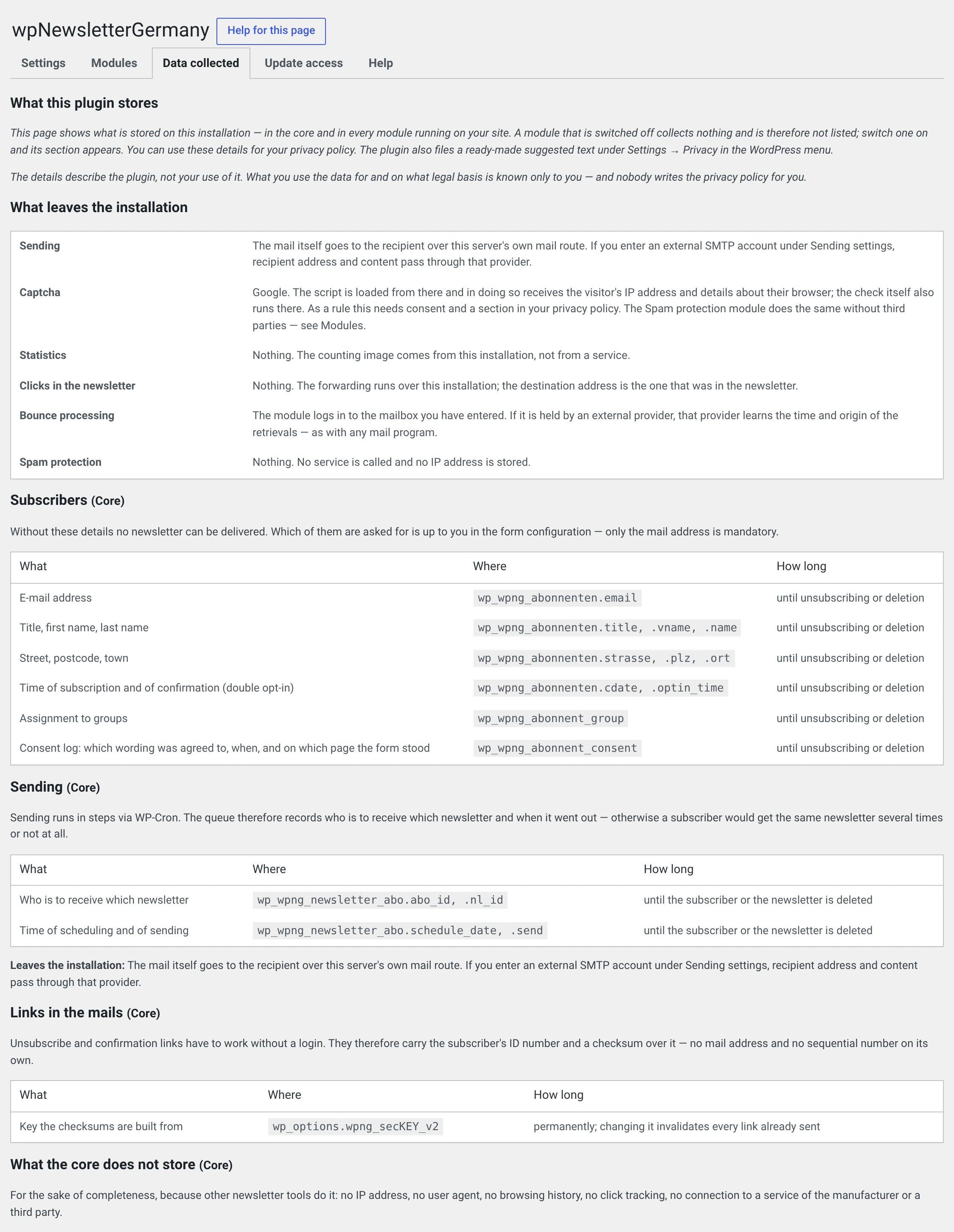
This is the page you write your privacy policy from
You are liable for your privacy policy. You can only write it if you know what is stored on your installation — and that depends on which modules you have switched on.
Until now you had to piece that together from the manual.
What the page shows
1. What leaves the installation — right at the top, because that is the question a privacy policy hangs on. Today that is the mail route, a third-party SMTP account if one is configured, the bounce processing mailbox and, if it is running, Google reCAPTCHA.
2. One table per area with What / Where / For how long. First the core, then every running module.
3. Modules with no statement — which running modules reported nothing.
4. Disclosure and erasure — the reference to the WordPress tools.
One section of the core is called „What the core does not store" and says explicitly: no IP address, no user agent, no click tracking, no connection to any service of the manufacturer.
It is there because other newsletter tools do it differently — and because otherwise you would put it into your policy just in case.
Only what is running in your installation
Only the switched-on modules are asked. A module that is off collects nothing and therefore does not appear on the page. Switch one on and its section appears.
Look here after every time you switch a module on or off
And adjust your privacy policy. That is the real purpose of this page: it changes with your installation.
Who reports what today
| Module | What |
|---|---|
| Core | The data from the subscription form, the consent record, the delivery rows |
| Subscriber fields | The answers to your fields — with their names, because only your installation knows them |
| Sending log | Who received which newsletter when; stores nothing additional itself |
| Statistics | Times and counts of opens and clicks. With the note that this is measuring behaviour and may require consent |
| Bounce processing | Recipient address, subject, text — and the complete headers, containing IP addresses of mail servers |
| Spam protection | Short-lived markers under a checksum, counters without personal reference, no IP |
| Captcha | Nothing on the installation — but the visitor's IP goes to Google |
„Modules with no statement"
At the end of the page are the running modules that reported nothing. Today those are Attachments, Placeholder rule, Post notification and the two interfaces.
Saying nothing and collecting nothing are two different things
For a supplied module it means: it stores nothing personal.
For a module you have put under user_mods it only means that nobody
asked. There you have to look for yourself.
That is why the distinction is made instead of lumping both together.
This page itself
It stores nothing and calls nothing. It reads what is there anyway.
For your privacy policy it is therefore the answer, not the subject.
For module authors
If you write a module of your own that stores something about the subscriber,
implement datenschutz_auskunft():
public function datenschutz_auskunft() {

    return array(
        array(
            'name'   => $this->name,
            'zweck'  => __( 'Why it is collected, in one sentence.', 'newsletter-germany' ),
            'daten'  => array(
                array(
                    'was'   => 'What is stored',
                    'wo'    => WPNG_TBL_BEISPIEL . '.column',
                    'dauer' => 'For how long',
                ),
            ),
            'extern' => '', // otherwise: what leaves the installation
        ),
    );
}
Just as you implement abonnent_delete() so that your record goes along when
a subscriber is deleted.
The core does not know what a module stores. That is the condition under which the split into two packages holds — every module supplies its own section.